Two form factors to capture meeting transcripts the way you want
The fastest way to pull video recordings, audio recordings, transcripts, and metadata, in real time or post-call. Recall.ai's Meeting Bot API & Desktop Recording SDK provides all the functionality you need from a meeting transcription API through one unified endpoint.
One meeting transcription API for every platform
Our API automatically supports Google Meet, Zoom, Microsoft Teams, Slack, and more. Get transcripts from each platform without rewriting code.


The easiest way to get meeting transcripts via API

Get meeting transcripts no matter the edge case

Capture every detail from every meeting
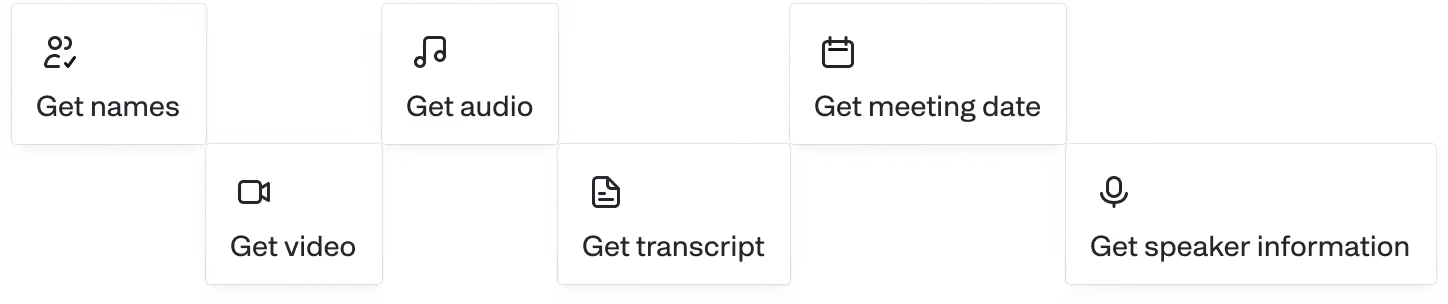
Retrieve audio, video, diarized transcripts, and metadata (participant emails, participant lists, meeting titles, etc) in real-time or asynchronously.

Scale up or down instantly
.svg)
Deploy in minutes, not hours
%20final.svg)
Get meeting context with our real-time transcription API
With Recall.ai, you don’t just get text. Access audio, video, and rich metadata in real-time or post call.
Keep your meeting data secure
Just call our API and we’ll handle scaling, reliability, and compliance, so your team can focus on creating the features your users love.

Reliable and stable

Onboarding support

Scalable infrastructure


Security controls
For more information, check out our security portal.

Frequently asked questions
A meeting transcription API is any API that programmatically provides meeting transcripts. At Recall.ai that functionality is available both in the Desktop Recording SDK and Meeting Bot API, both of which provide additional data.
Yes. Recall.ai's Desktop Recording SDK and Meeting Bot API work across all major platforms.
Yes. The Recall.ai Meeting Bot API and Desktop Recording SDK both deliver real-time transcripts via webhook and offer transcripts after the call via API endpoint.
Yes, Recall.ai is SOC 2, ISO 27001:2022, GDPR, CCPA, and HIPAA compliant.
Yes. You can provide your own transcription API keys for one of our supported transcription providers or use Recall.ai Transcription to transcribe your meeting.
We can either store your data or you can set custom retention for all of your meeting data, including transcripts, depending on your needs and compliance requirements.
Since accuracy depends on the transcription provider you choose, it is recommended that you run the same meetings through several providers to determine which provider is going to be the best fit for your language. Recall.ai integrates with several transcription providers so you can connect the speech-to-text engine that best matches your needs for language, accuracy, and cost.
You can get recordings and transcripts in addition to metadata, speaker names, timestamps, and participant emails.
They're often used interchangeably. Both meeting transcription API and meeting transcript API refer to an API that allows access to transcripts for meetings hosted on meeting platforms such as Zoom, Microsoft Teams, or Google Meet.
Recall.ai's meeting transcription supports over 30 languages using Recall Transcription. Other transcription providers support varying numbers of languages. Recall.ai's Transcription API allows you to connect to Recall.ai Transcription or other providers. Check out Recall.ai's Microsoft Teams Transcription API page to learn about the ways to get transcripts from a Microsoft Teams meeting.
Real-time transcription provides instant text live use cases, while batch transcription processes pre-recorded audio asynchronously.
Yes. You can sign up for self-serve and get your first several hours free to test on Recall.ai.
Any company looking to capture conversations can use Recall.ai. We automate meeting notes and meeting analysis across industries, including tools to get insights from 1:1 meetings, automated interview scorecards, notetakers for financial advisors, conversation intelligence for sales calls, and AI scribes.


